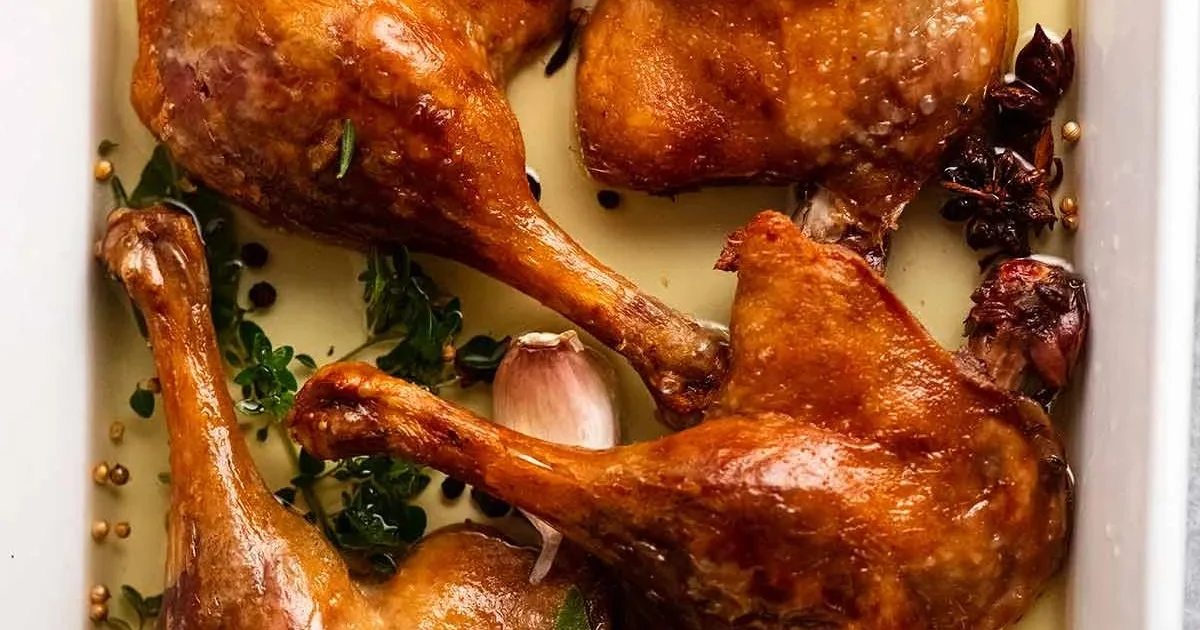
Authentic French Duck Confit (Confit de Canard)
Master the art of traditional French Duck Confit with this foolproof recipe. The duck is cured with aromatics and slow-cooked in its own fat until the meat is succulent and the skin is irresistibly crispy.
Servings4 Portions
Prep Time15 Mins
Cook Time530 Mins
Difficulty
Intermediate
Ingredients
4
- duck legs4
- duck fat750 ml
- cooking/kosher salt4 tsp
- thyme sprigs0.3 cup
- sage sprigs0.3 cup
- rosemary sprigs0.3 cup
- oregano sprigs0.3 cup
- garlic6 clove
- eschalot1
- black peppercorns1 tbsp
- coriander seeds1 tbsp
- star anise8
- bay leaves2
- juniper berries2 tbsp
Step-by-Step Instructions
01
In a large mixing bowl, combine the duck legs with the salt, thyme, sage, rosemary, oregano, garlic, sliced eschalot, peppercorns, coriander seeds, star anise, bay leaves, and juniper berries. Toss thoroughly by hand to ensure the legs are evenly coated in the dry cure.
02
Arrange the duck legs in a single layer in a ceramic or glass baking dish, fitting them snugly. Cover tightly and refrigerate for 12 to 24 hours to allow the flavors to penetrate the meat.
03
Remove the duck from the refrigerator. Brush off the cure and rinse each leg under cold running water to remove all salt and spices. Pat the legs completely dry with paper towels; moisture is the enemy of a good confit.
04
Preheat your oven to 100°C (210°F) or 80°C for fan-forced ovens. Place the duck legs in a small, high-sided metal roasting pan, ensuring they fit closely together in a single layer.
05
Pour the duck fat over the legs until they are almost entirely submerged. Place the pan on the stovetop over medium-high heat and bring the fat to a steady bubble across the entire surface.