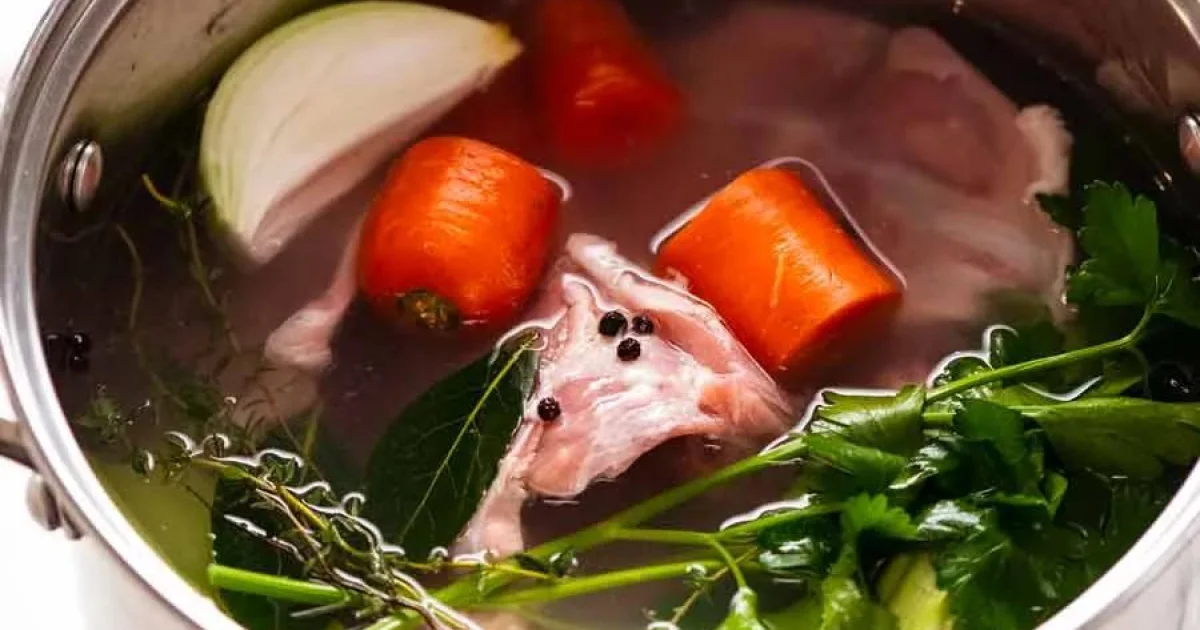
Homemade Chicken Stock
This homemade chicken stock is rich, clear, and deeply savory, made by gently simmering chicken bones with vegetables, herbs, and aromatics. Use it as a flavorful base for soups, sauces, risotto, casseroles, and any recipe that calls for chicken broth or stock.
Servings2 Portions
Prep Time15 Mins
Cook Time180 Mins
Difficulty
Easy
Ingredients
2
- chicken frames2 kg
- carrot1
- onion, thickly sliced0.5
- celery stem1
- black peppercorns0.5 tbsp
- apple cider vinegar1 tbsp
- bay leaves2
- thyme sprigs2
- parsley sprigs3
- cold water3 L
Step-by-Step Instructions
01
Add the chicken frames, carrot, onion, celery, peppercorns, apple cider vinegar, bay leaves, thyme, parsley, and cold water to a large stockpot of at least 7 liters.
02
Place the pot over medium-high heat and bring it just to a boil. As foam rises to the surface, skim it off with a ladle and discard it for a cleaner-tasting, clearer stock.
03
Reduce the heat to low and simmer uncovered for 3 hours. Keep the surface barely moving with only the occasional gentle bubble; avoid a hard boil, which can make the stock cloudy.
04
Strain the stock through a fine-mesh sieve into a clean pot or large heatproof bowl. For easier handling, remove the bones and vegetables with a slotted spoon before straining.
05
Check the yield. You should have about 2 liters of stock. If you have much more, simmer it gently to reduce and concentrate the flavor; if you have less, add a little water to bring it back to 2 liters.
06