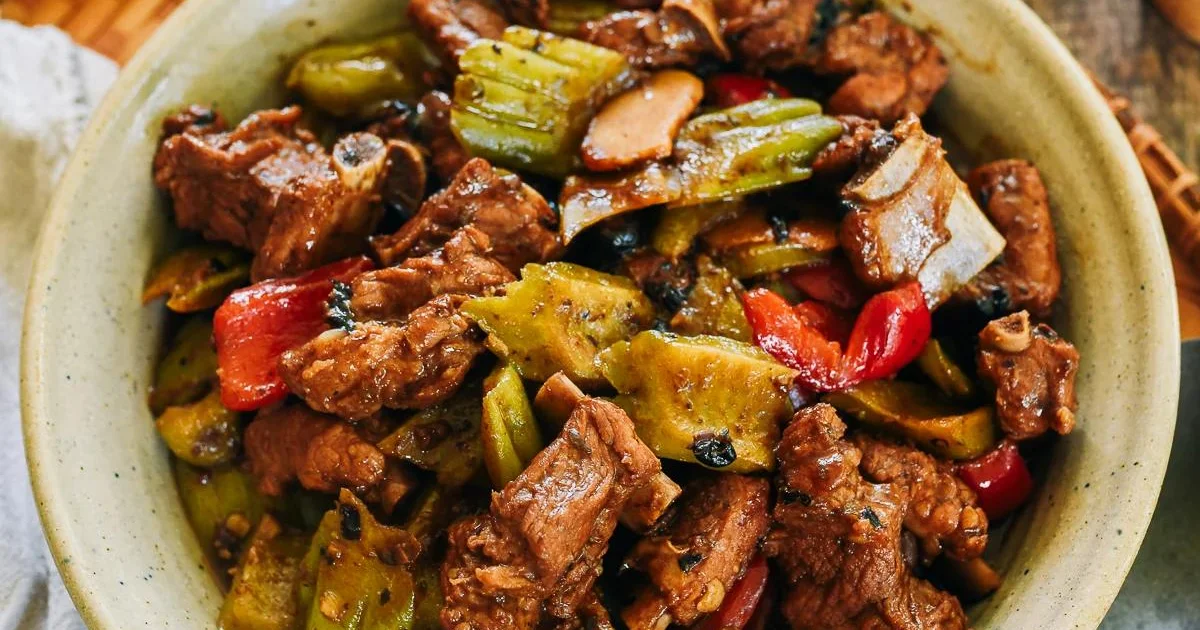
Cantonese Braised Pork Ribs with Bitter Melon
A quintessential Cantonese comfort dish that balances the rich, savory depth of fermented black beans with the refreshing, crisp bite of bitter melon. The pork ribs are braised until tender in a fragrant sauce, creating a complex flavor profile that is perfect when served over steamed white rice.
Servings6 Portions
Prep Time75 Mins
Cook Time50 Mins
Difficulty
Intermediate
Ingredients
6
- pork ribs1.5 lb
- Chinese bitter melon1.5 lb
- red bell pepper1 piece
- ground ginger3 slice
- garlic cloves, minced6 clove
- cornstarch2 tsp
- white pepper0.3 tsp
- Shaoxing wine1 tbsp
- light soy sauce0.5 tbsp
- dark soy sauce0.5 tsp
- neutral oil3 tbsp
- whole fermented black beans2 tbsp
- chee hou sauce1 tbsp
- oyster sauce1 tbsp
- boiling water1.8 cup
- salt1 pinch
Step-by-Step Instructions
01
Begin by soaking the pork ribs in cold water for 1 hour to remove impurities, changing the water once at the 30-minute mark. While the ribs soak, prepare the bitter melon: slice in half lengthwise, use a spoon to scrape out all seeds and the white pith, then slice at a 45-degree angle into 1/2-inch thick pieces. To mellow the bitterness, blanch the melon pieces in boiling water for 1 minute, then drain and set aside.
02
Drain the soaked ribs and pat them thoroughly dry with paper towels. In a large mixing bowl, combine the ribs with cornstarch, white pepper, Shaoxing wine, light soy sauce, and dark soy sauce. Toss well to ensure even coating and let marinate for at least 20 minutes.
03
Heat a wok or large heavy-bottomed pan over medium-high heat. Add 1 tablespoon of neutral oil. Stir-fry the blanched bitter melon and sliced bell pepper for about 3 minutes until slightly softened but still vibrant. Remove the vegetables from the wok and set aside.
04
Add another tablespoon of oil to the same wok. Add the marinated ribs in a single layer and pan-fry until they are lightly browned and caramelized on all sides. Stir occasionally to prevent the cornstarch marinade from sticking to the bottom.