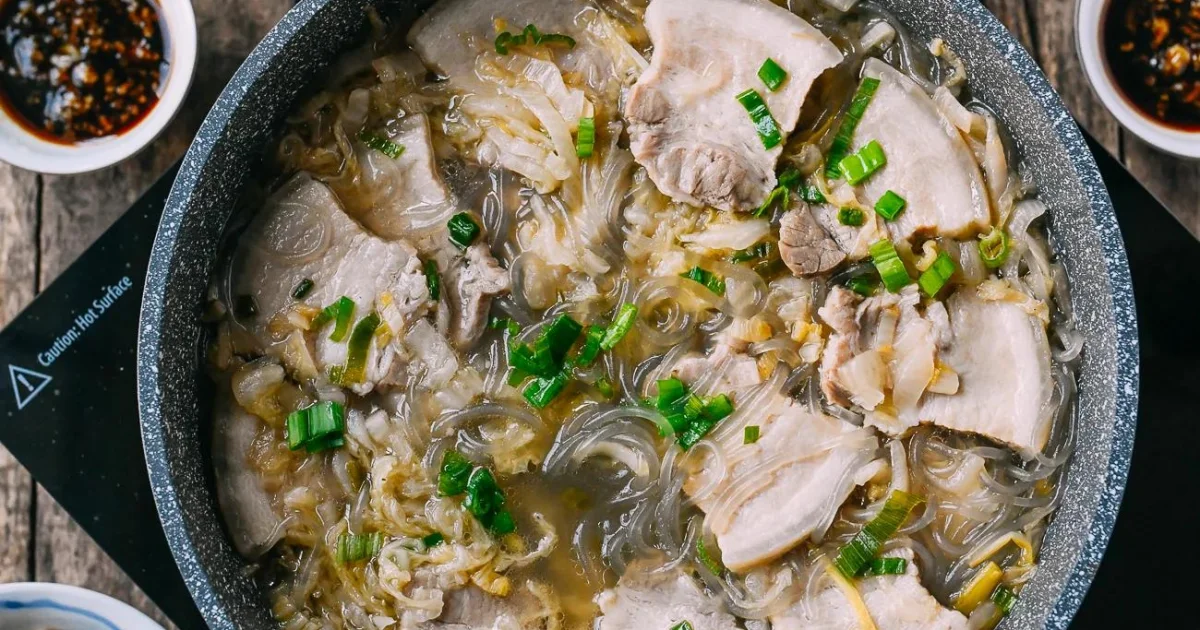
Northern Chinese Sour Cabbage Stew with Pork and Glass Noodles
A comforting and tangy Northern Chinese classic featuring tender pork belly, fermented sour cabbage, and chewy glass noodles. This hearty stew delivers a deeply satisfying savory-sour broth that is perfect for cold weather.
Servings6 Portions
Prep Time30 Mins
Cook Time40 Mins
Difficulty
Intermediate
Ingredients
6
- pork belly1 lb
- Chinese sour cabbage1 lb
- dried sweet potato starch noodles3 oz
- boiling water4 cup
- chicken stock1 cup
- Shaoxing wine2 tbsp
- Vegetable oil2 tbsp
- light soy sauce2 tbsp
- oyster sauce1 tbsp
- ground ginger4 slice
- scallions2 pcs
- garlic3 clove
- Sichuan peppercorns1 tsp
- salt0.5 tsp
- white pepper0.3 tsp
- sugar0.3 tsp
- star anise1 pc
- chili oil1 tbsp
Step-by-Step Instructions
01
Prepare the pork base: In a medium heavy-bottomed pot, combine the water, whole pork belly (or ribs), Shaoxing wine, ginger slices, scallions, Sichuan peppercorns, star anise, and salt. Bring the mixture to a boil over high heat.
02
Simmer the meat: Once boiling, reduce the heat to medium-low, cover, and simmer for 15 minutes. If using pork belly, remove it from the pot to cool and reserve the stock. If using ribs, leave them in the hot stock with the heat turned off to continue softening.
03
Mix the dipping sauce: In a small bowl, combine the minced garlic, light soy sauce, sugar, and chili oil. Stir well and set aside to serve with the finished pork.
04
Prep the sour cabbage: Slice the sour cabbage into strips about 1/4-inch (0.6 cm) thick. Place them in a large bowl of fresh water and agitate with your hands. Drain and squeeze the cabbage thoroughly to remove excess water; this mellows the intense saltiness and acidity.
05