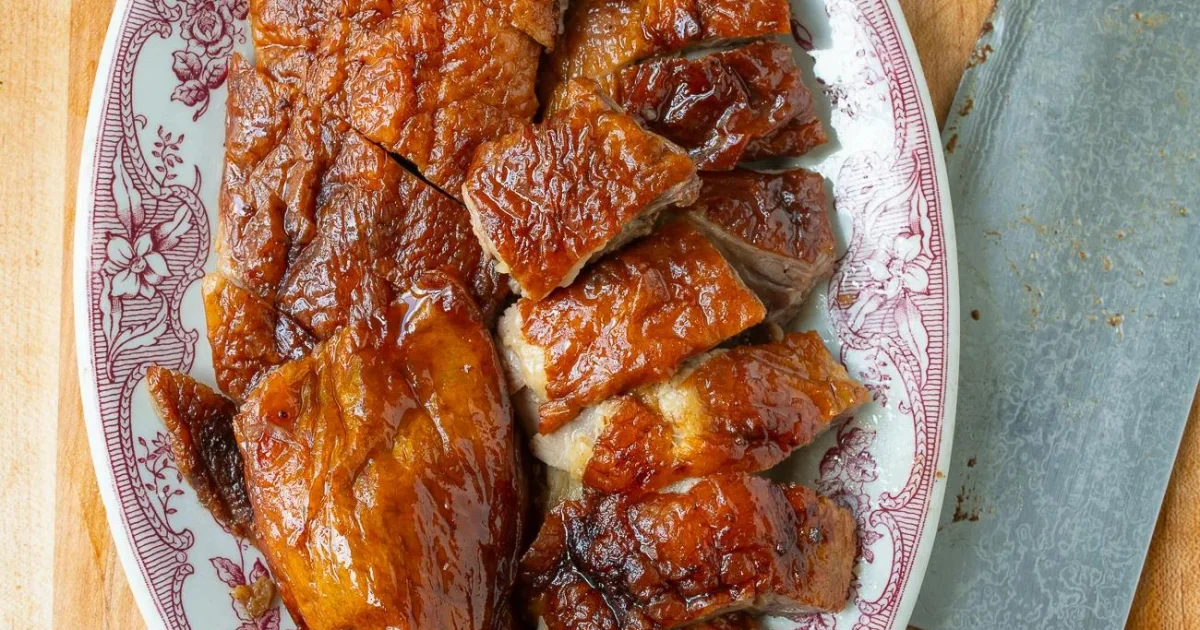
Authentic Chinese Roast Duck with Crispy Skin
Master the traditional art of Chinese roast duck with this detailed guide. By using the air-inflation technique and a signature maltose glaze, you'll achieve succulent, aromatic meat and that iconic, glass-like crispy skin.
Servings6 Portions
Prep Time1680 Mins
Cook Time120 Mins
Difficulty
Advanced
Ingredients
6
- Long Island duckling1
- fine sea salt1.5 tbsp
- five-spice powder2.5 tsp
- sugar2 tsp
- sand ginger powder1 tsp
- Shaoxing wine2 tbsp
- chee hou sauce2 tbsp
- ground bean sauce1 tbsp
- hoisin sauce1 tbsp
- oyster sauce1 tbsp
- red fermented bean curd1 tbsp
- neutral oil2 tsp
- fresh ginger2 slice
- medium garlic cloves2
- scallions1
- dried bay leaves2
- star anise2
- Chinese cassia cinnamon stick1
- piece dried mandarin orange peel1
- Chinese red vinegar3 tbsp
- maltose2 tbsp
- boiling water1.5 l
- hot water0.5 cup
Step-by-Step Instructions
01
Prepare the duck by trimming excess fat from the cavity while keeping the skin intact. Use a sharp cleaver or kitchen shears to remove the wing tips and the feet at the leg joints.
02
Clean the duck thoroughly. Use tweezers to pluck any remaining pinfeathers and ensure all internal organs, including the lungs and kidneys, are removed from the cavity. Rinse well and pat the entire duck—inside and out—completely dry with paper towels.
03
Prepare the internal dry rub by mixing the salt, five-spice powder, sugar, and sand ginger powder. Rub the inside of the cavity first with Shaoxing wine, then thoroughly coat it with the spice mixture. Refrigerate the duck uncovered for 1 hour.
04
Make the cooked marinade: In a bowl, whisk together the chee hou sauce, warm water, ground bean sauce, hoisin, oyster sauce, and red fermented bean curd. Heat neutral oil in a saucepan over medium-low heat and sauté the ginger for 30 seconds. Add the garlic, scallion, bay leaves, star anise, cinnamon, and orange peel, cooking until fragrant. Pour in the sauce mixture, bring to a simmer, then remove from heat and let it cool completely.